
I know you’ve all been on the edge of your seats, couches and bikes in the past week wondering if both mechanical energy and momentum are conserved in a collision.
Well, the answer is…sometimes. Let’s delve.
A collision in which the internal forces are conservative is an elastic collision. In such a case both total momentum and total energy are constant. So, during a collision of this ilk, all the initial KE not required to conserve momentum is converted to U (potential energy) and, after the collision, all the U is converted back to KE. Think about our mini-billiard balls colliding!
Now, let’s think about a “fruit fight”. If two apples are traveling horizontally through the air and they collide, they will explode. Our flying fruit have no chance to return to their original form, in some cases they might even stick together. This is an example of an inelastic collision and it is here where mechanical energy is not conserved and we say KE has been dissipated. And we can quantify the amount of KE that was lost by comparing the KE before the interaction with the KE after the collision. If the objects stick together, it is referred to as a completely inelastic collision and we use the combined mass in the kinetic energy equation.
So let’s take a look at the interaction between Sydney and Jaromir again here, along with another example of a head-on collision during a stunt scene in Mission: Impossible 13; Zero Velocity, to see if we can grasp the concept.
In filming Mission Impossible 13: Zero Velocity, a 1500 kg car moving north at 35.0 m/s collides head on with a 7500 kg truck moving south at 25.0 m/s. The car and the truck stick together.
(a) How fast and in what direction is the wreckage traveling just after the collision?
(b) How much mechanical energy is dissipated in the collision?
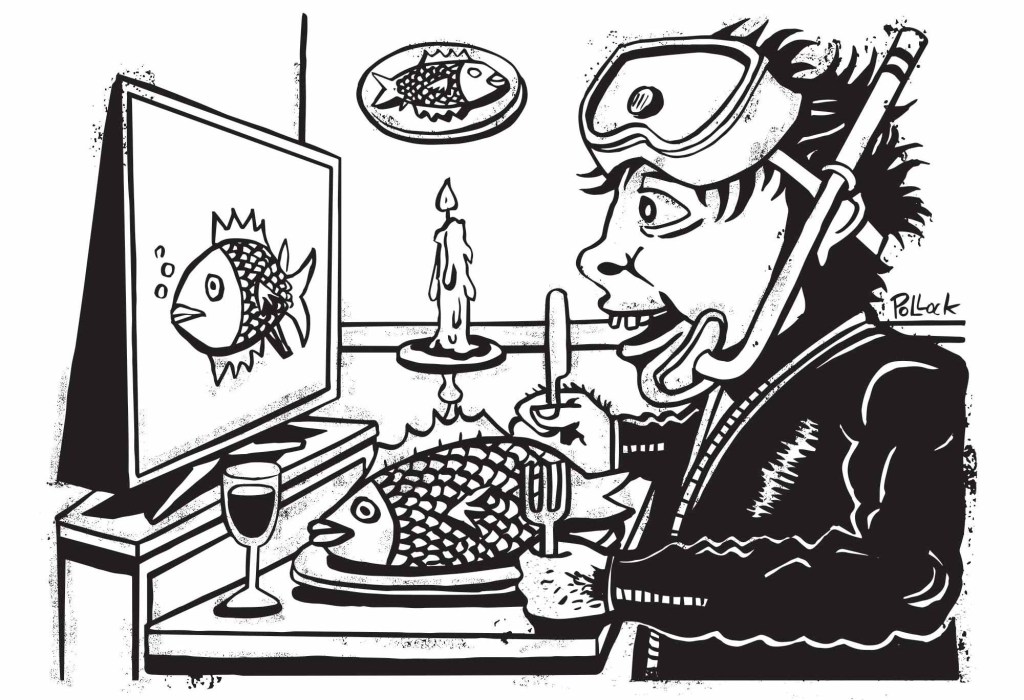
Have a go…A large bass with a mass of 25.0 kg swims at 1.00 m/s towards and swallows a small fish that was stationary. If the smaller fish has a mass of 1.00 kg, what is the speed of the bass immediately after it dines? What type of collision is this? What is the percentage of kinetic energy dissipated, if any? Answer
And finally, I wanted to end with a look at how collisions in two dimensions can be quite daunting. I would love for you to appreciate this complexity qualitatively more than quantitatively for the moment!!
Thanks for being such amazing students!!


 Film Clas