
This video depicts was one of my best Halloween costumes. I even had the squash racquet!! I lost the contest to a Banana but I love airport walkways! The feeling of being fast or the accomplishment of treading against the moving earth are exhilarating!!
If you recall, in linear motion with constant acceleration, we were able to use a set of equations that related position, velocity and acceleration for analysis. Similarly, in rotational motion with constant angular acceleration, the same relationship appears for the rotational equivalents of the corresponding quantities in straight-line motion!! Therefore, we can define angular acceleration as the rate at which the angular velocity changes with respect to time in much the same way that we defined acceleration of an object moving in a straight line.

Now just as in straight line motion, a positive value of angular acceleration does not necessarily mean the extended object’s rotation is speeding up and a negative value doesn’t necessarily correspond to slowing down. If angular velocity (w) and angular acceleration (alpha) have the same algebraic sign, the extended object is speeding up. Conversely, if w and alpha the opposite sign, the object is slowing down. Now, let’s have go at the spinning top example!!
OK!! Let’s think practically and qualitatively about what’s happening here (also a bit old school!).

Optical disk drives, such as CDs and DVDs, have information stored in small depressions “burned” onto the disk surface. Hence the term, “burning a CD” which is what we were doing when we downloaded songs off Napster at the turn of the century! Anyway, a laser is used to detect changes in the depth on the surface as the disk spins. A change is interpreted as a 0 and no change in depth is interpreted as a 1. There are millions of these burns on a disk’s surface and the DVD player retrieves this stored information. Now, these optical technologies are designed to maintain a constant rate of information retrieval. If the laser samples depth on the surface at constant intervals of time, why do you think the angular velocity of the disk cannot be constant?
Let’s see if we can answer these questions!!
(1) Orla pushes a merry-go-round that has a diameter of 4.00 m and goes rest to an angular speed of 18.0 rpm in a time of 43 s.
(a) Calculate the angular acceleration of the merry-go-round in rad/s^2.
(b) Calculate the angular displacement (in radians) of the merry-go-round during this time interval.
(c) What is the maximum linear speed of Orla if she rides on the edge of the platform?
(2) Interpreting Data!!
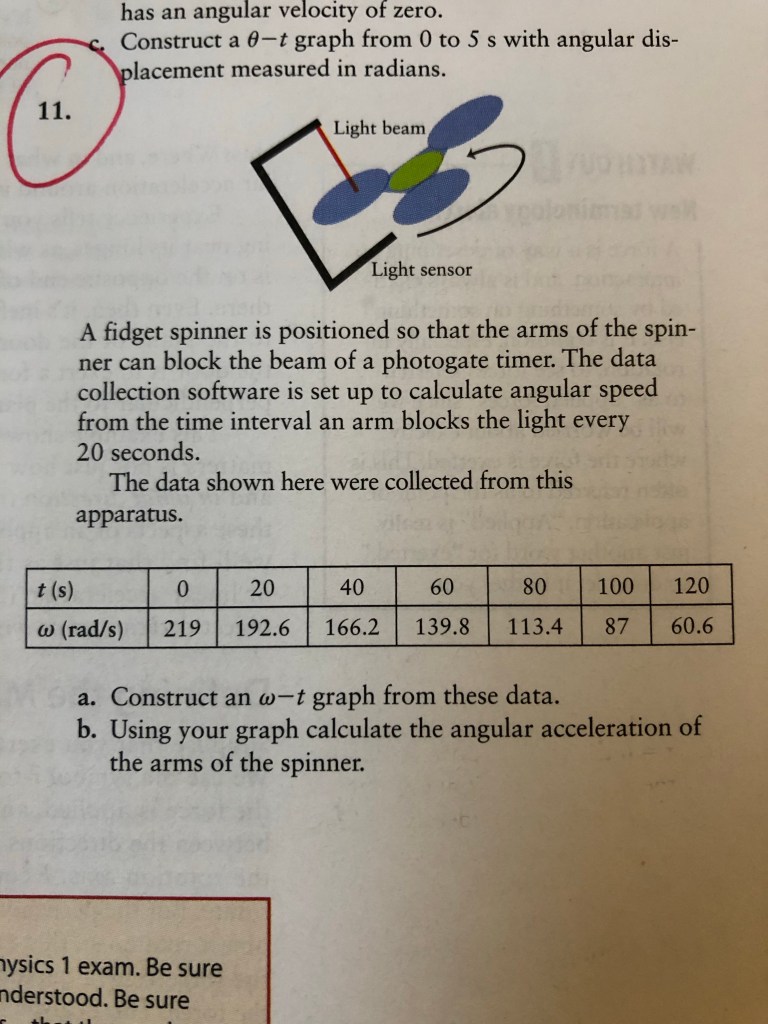
I have provided the answers for the Pure Roll worksheet and the notes for the Hoop and Disk race scenario about rotational inertia. I have also written out a couple of problems that might put a bow on these moments (of inertia).
Thanks so much!! Y’all are wonderful!!
 Film Clas