
A lawnmower starter is a flywheel and a great example of our learned ability to manipulate torque!
Simply opening a door can tell us so much! We have the door handle as far away from the hinges as possible and we want to push perpendicular to the plane of the door. This is a great model as to how giving an extended object angular acceleration is not only dependent on how hard you push but also where and in what direction you push. The physical quantity that relates all of these aspects of an applied force is called the torque associated with said force. In perfect harmony with Newton’s 2nd Law, the net external torque determines the angular acceleration just as net force determines linear acceleration!!
So, we use r to denote the vector from the rotation axis to the point where the force is applied and we use the symbol (phi or theta) for the angle between the directions of r and F. It is the perpendicular component of the this force that makes the object rotate, F sin (theta). This is torque!!
Torque (tau) = rF sin (theta)
…where r is the distance from the rotation axis to where the force is applied and theta is the angle between the vector r (from the axis to where the force is applied) and the force vector F.
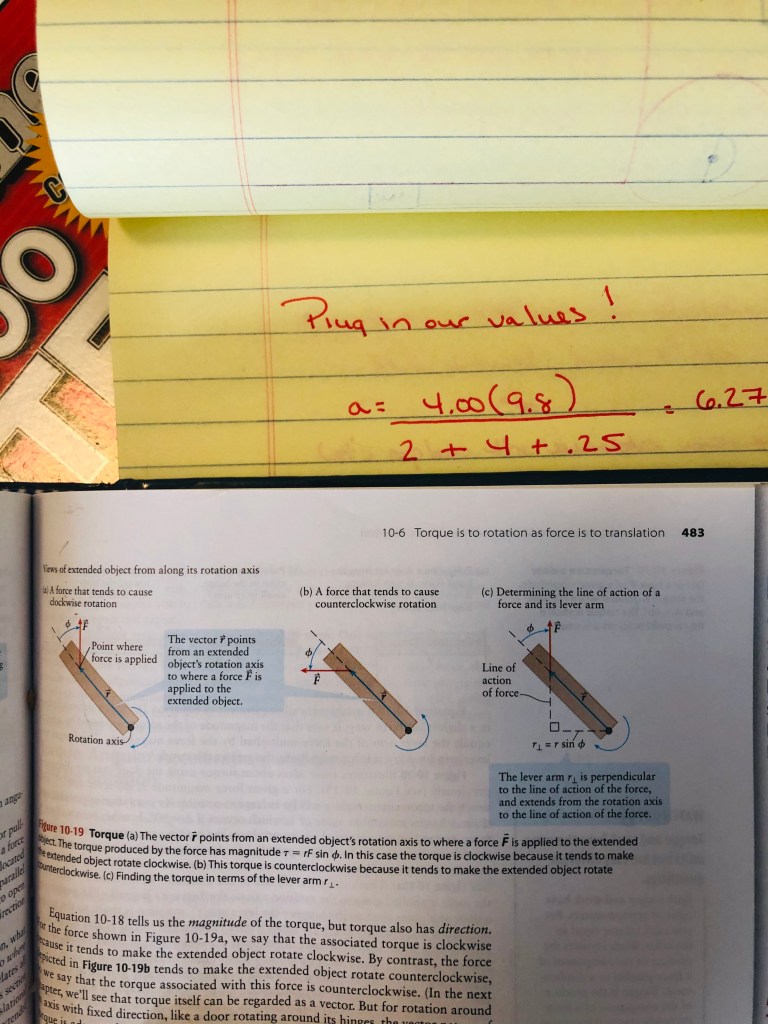
Torque has direction in terms of clockwise (-) and counterclockwise (+). In the photo above, part (c) shows the “line of action” of the force as the extension of the force vector through the point where the force is applied. The lever arm or moment arm is the perpendicular distance from the rotation axis to the line of action of the force, r (perpendicular) = r sin (theta) and we are left with same quantity as before.
tau = r (perpendicular) F
r (perpendicular) represents the lever arm! So the longer the lever arm, the greater the torque for a given amount of force! So even a small force can generate a large torque of the lever arm is long enough!
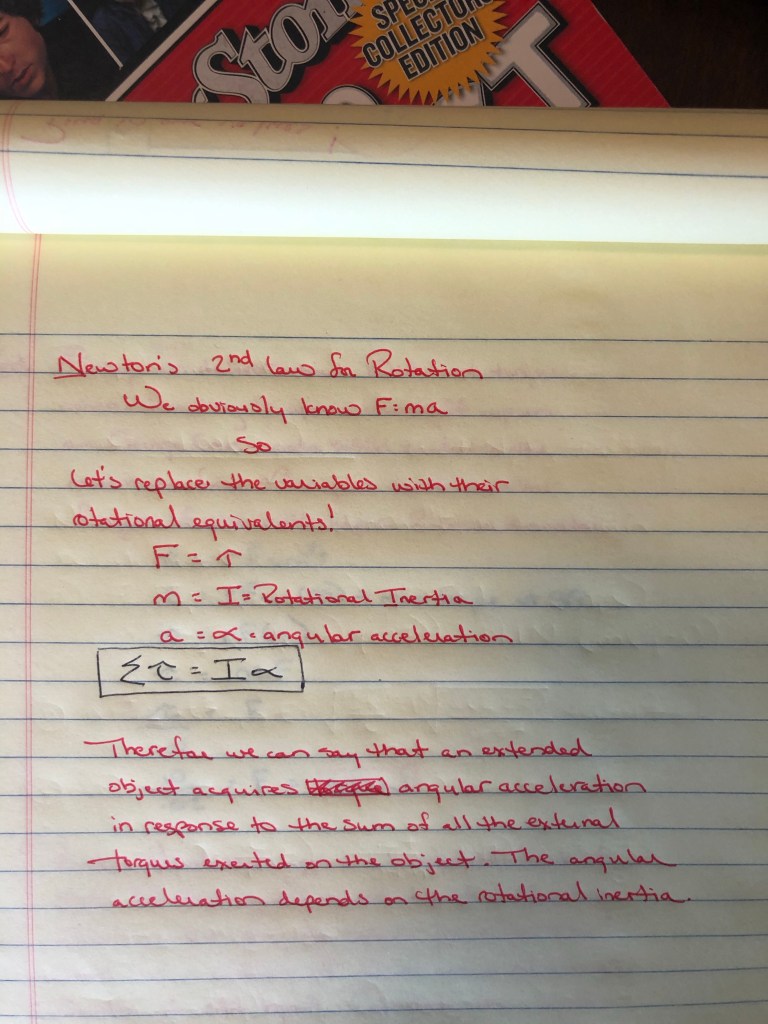
Now that we have a general knowledge of torque, let’s have a go at a few problems!!
(1) Marcy can deliver about 10 Nm of torque when attempting to open a twist off cap on an Orange Crush soda bottle. What is the maximum force Marcy can exert with her fingers if the bottle cap’s diameter in 2 cm?
(2) Bettina Henderson applies a horizontal force of 20 N (to the right) to the top of a steering wheel on the way to soccer practice. The wheel had a radius of 18 cm and a Rotational Inertia of .097 kgm^2. Calculate the angular acceleration about the central axis due to the force.
(3) Many 6.35 cm-diameter computer hard disks spin a t a constant 7200 rpm operating speed. The disk’s have a mass of about 7.50 g and are essentially uniform throughout with a small hole in the center. I = 1/2mr^2.
(a) if the disk reaches its operating speed 2.50 s after the drive is turned on, what average torque does the drive supply to the disk during the acceleration?
(b) calculate the change in Kinetic Energy of the disk and the average power delivered to the drive as it accelerated to operating speed.
(4) A block of mass m1 = 2.00 kg rests on a table that exerts a negligible friction force on the block. The block is connected with a light string over a pulley to a hanging mass m2 = 4.00 kg. The pulley is a uniform disk with a radius of 4.00 cm and a mass of .500 kg. The rotational inertia of a uniform disk is 1/2mr^2.
(a) Calculate the acceleration of each block and the tension in each segment of the string.
(b) Calculate how long it takes the blocks to move a distance of 2.25 m.
(c) Calculate the angular speed of the pulley at the instant the blocks are moved.
Here are a couple for home!!
(1) Shawna, a 45 kg high diver, launches herself from a springboard that is 3.0 m above the water’s surface, so that she ends up with a 5.0 m fall from rest before she reaches the surface of the water. Calculate the time it takes Shawna to descend the 5 m to the surface of the water and the angular speed that will allow Shawna to complete 2.5 turns while in the air!
(2) Sarah’s potter wheel is mounted on a shaft with bearings that exert a negligible friction force, the wheel is initially at rest. A constant external torque of 75 Nm is applied to a wheel for 15 s, giving the wheel an angular speed of 500 rpm in the counterclockwise direction when viewed from above.
(a) Calculate the magnitude of the angular acceleration of the wheel in rad/s^2. What is its direction?
(b) Express the rotational inertia of the wheel in terms of the torque exerted on the wheel and the angular acceleration of the wheel.
(c) calculate the value of the rotational inertia of the wheel.
(d) The external torque is removed and a brake applied. If it takes the wheel 200 s to come to rest after the brake is applied, what is the magnitude and direction of the torque exerted on the brake?
OK! So, here is the answers for the cart/wheel worksheet from last week and here is a new wheels worksheet along with the answers!!!
Here is another problem with its solution, of a tension force rotating a cylinder. I also wanted to add the solution to the torque ruler scenario we went over before we left school.
I know this is a lot but it is basically all of torque. We will be here for a little bit.

Thanks so much everybody!! You all are incredible!!!
 Film Clas