

We live in a world of oscillations!! You can try keeping your body absolutely still but your heart will still beat and your lungs will still expand and relax. All the while, electrons move back and forth about 60 times/sec as part of the process to supply energy to the LCD screeen on your iPhone!
Oscillations are characterized as movement of an object back and forth around a specific point of equilibrium, that is, a point of zero force. Oscillations have a cycle, occurring as a repeating pattern. The time for one complete cycle is called the Period (T) of an oscillation.

The cyclic appearance of Venus proved Copernicus’ sun centric solar system!

The simplest form of oscillation occurs when the restoring force obey’s Hooke’s Law. That is, when the restoring force is directly proportional to the distance that the oscillating object is displaced from equilibrium. This is called an Ideal Spring.
F = -kx
The negative sign indicates that the force is always opposite the displacement.
Shelly exerts a force of 10 N on a spring, stretching it a distance of 20 cm.
(a) How far will the spring stretch if a force of 20 N is exerted on it?
(b) What is the spring constant of the spring?
Please enjoy the amazing Trey Anastasio manipulating SHM.
We know the Period (T) is the time it takes to complete one cycle in SHM. Frequency (f) is equal to the number of oscillations per unit time. We usually assign the unit Hertz (Hz) to frequency that basically means “anything per second”.
Since (T) is the number of seconds elapsed per cycle and (f) is the total number of cycles per second, it stands to reason that these quantities are reciprocals. This is very useful!
f = 1/T and T = 1/f
Farrah has a resting heart rate of 50 beats/min. When Farrah sprints a lap on the track, her pulse increases to 150 bpm. Compared to when she is at rest, the period of her heart rate when she is sprinting is
(a) 9x (b) 3x (c) same (d) 1/3x (e) 1/9x
(a) What is the oscillation period of your eardrum when you are listening to the A4 note on the piano when Buddy Strong rips a cord? (f = 440 Hz)
(b) A bottle floating in the ocean bobs up and down once every 2.00 minutes. What is the frequency of this oscillation?
The speed of a computer processor is sometimes indirectly given by stating the frequency at which it electrically oscillates between two states. One such processor is said to operate at 3.1 GHz. What is the period of this processor’s electrical oscillation?

In the above image, you will also notice four important formulas that govern SHM. They describe angular frequency, period, frequency and linear speed of an object in SHM. Let’s put those formulas to the test!!
Walking through Red Rocks, you notice a woodpecker. Now a woodpecker has amazing reinforced skull bones that allow it to peck at a tree without getting a headache!! If you and Jeremy notice that a woodpecker pecks at a tree with a frequency on 22 pecks/second with a peck amplitude of 0.03 m. What is the maximum head speed of this wonderful bird?
Now here’s a tougher one!!
An object of mass 0.80 kg is attached to an ideal horizontal spring that has a spring constant of 180 N/m and is set onto oscillation on a frictionless surface.
(a) Calculate the angular frequency, period and frequency of the block.
(b) Calculate the angular frequency, period and frequency of the mass of the block is quadrupled to 3.2 kg.

Here are a few more fun SHM questions to polish up your skills!
Paula operates a sewing machine with a needle that moves in SHM as it sees a seam. If the needle moves 8.4 mm from its highest to lowest position and it makes 24 stitches in 9.0 s. What is the maximum needle speed as Paula sees some napkins?
The prong of a tuning fork moves back and forth when it is set into SHM. The distance the prong moves between its extremes positions is 2.24 mm. If the frequency is 440 Hz, what is it’s maximum velocity!
Answers!!
Remember how a spring could be used to store energy. We mentioned this when we talked about the kangaroo hop. The ‘Roo’s tendons act like springs to store spring potential energy, U(spring), which is transformed into kinetic energy when the Roo hops. This observation, along with how a dolphin can swim in an energy efficient manner by utilizing the spring energy in its tail, make it important to look at oscillations from the energy perpspective!
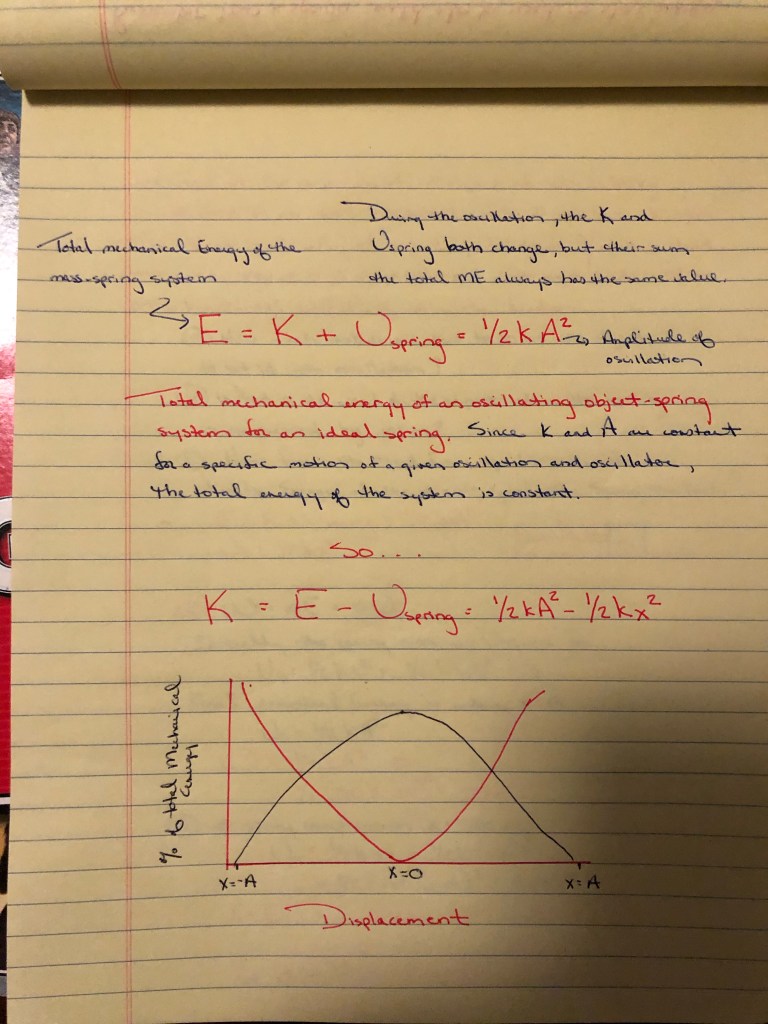
Now, let’s get right into some examples of how we can use Energy to determine position and velocity during an oscillation.
Have any thoughts on this question?
Arthur attaches an object to the end of a spring so it slides back and forth on horizontal surface without friction. The motion is SHM between A and -A. Predict the times at which the object’s K and Us of the system have the same value.
Pendulums!!
I always like to start this unit with a little anecdote!
What do Miley Cyrus and Edgar Allen Poe have in common, besides being great American writers?

The simple pendulum consists of a small object suspended from the end of a lightweight cord. We assume the cord doesn’t stretch and it’s mass can be ignored compared to that of the “bob”. The motion of the simple pendulum back and forth resembles SHM small amplitude oscillations.
The “bob” oscillates along the arc of a circle with equal magnitude on either side of its equilibrium point, or the point where it would hang vertically, where it has its maximum speed! Now we have pendulums everywhere from swingsets to hypnotizing pocket watches. Even our lower leg when we get our reflexes tested can be considered a simple pendulum!!

So we see, just like like with an oscillating spring-mass system, the period (T) of oscillation does not depend on amplitude (angle displaced from vertical) as long as there are small amplitude oscillations. Galileo is said to have first noted this fact whilst watching a swinging lamp in the cathedral of Pisa. The discovery led to the invention of the pendulum clock, the first really precise timepiece, which became the standard for centuries.
Period, frequency and angular frequency are also independent of mass!! Increasing mass increases the inertia but also increases the restoring force, gravity!!
So, if the period of a simple pendulum is T and we increase its length so that it is 4x larger, what will the new period be?
a) T/2 b) T c) 2T d) 4T
1.) A mechanical grandfather clock is driven by the motion of a pendulum, which has a period of a pendulum, which has a period of 2.00 s (and marks the time with each 1.00 s half cycle). What must be the length of pendulum??
2.) A simple pendulum on the surface of Earth is 1.24 m long. What is the angular frequency of the oscillation?
HERE are a couple more questions and the answers!!
Folks!! Here is your QUIZ!!

Thanks everyone!! You are the best!!
 Film Clas