

A point on the outside of a turntable moves a greater distance in one complete rotation than a corresponding point on the inside. If something moves a greater distance in the same time, this means a greater speed. So the linear or tangential speed is greater on the outside of a rotating object than inside and closer to the axis. This is still denoted with a v and is measured in m/s.
Angular speed, denoted by w, refers to the number of revolutions per unit time. Since all parts of the turntable rotate about the axis in the same amount of time, all parts have the same number of revolutions per unit time. That is, they “sweep” out the same angle no matter their distance from the axis! The angular speed is usually expressed in RPM and for analysis we like to convert it to rad/s as w is also equal to change (theta)/time, using this conversion factor.
2(pi) radians/revolution
Tangential speed and rotational speed are directly related by the formula
v = wr

Angular Speed of a DVD!!
On a DVD, visual and audio data are stored in a series of tiny pits that are evenly spaced along a long spiral that spans most of the surface of the disk and extends from the inner edge to the outer edge. The scanning laser in a DVD player reads the information at a constant rate. As the player reads closer and closer to the outer edge of the DVD, should the disk rotate…
(a) faster (b) slower (c) the same speed
In order to read the info at a constant rate, the same linear distance along the spiral must pass the reader in a given rate of time, regardless of radius. Distance in this case is the length of the circular arc, which is given be r((delta)(theta)). In order for this to remain constant, as r increases the angular displacement (change(theta)), in any fixed amount of time, (w), must decrease, v = wr, So as the scanning laser gets closer to the edge, the angular speed must decrease! The answer is (b).
So, at the end of the day, tangential speed is directly proportional to both angular speed and radius!
Rotational Inertia!!
The property of an object to resist changes in its rotational state of motion is called rotational inertia. This is the rotational equivalent to mass. An object rotating about an axis tends to remain rotating unless acted upon by an external torque, the rotational equivalent to force.
Rotational inertia, I, depends on the distribution, of mass around the axis of rotation. The further the the distribution of the mass from the axis, the greater the rotational inertia, I. The greater the I, the harder it is to change the state of rotation of the object.

The rotational inertia of any object depends on the mass distribution around its axis. A pencil can be rotated around three (3) different axes and therefore has three different rotational inertias. Sometimes a player will choke up on the baseball bat with 2 strikes in order to protect the plate. Why do you think they do this in terms of rotational inertia? Besides Barry Bonds, has a power hitter ever choked up on the bat?
How should you balance a hammer on your finger?
HERE is a super fun way to to analyze rotational motion down a ramp!!


Torque!!
This arm wrestling video and subsequent diagram and input is a really fun way to look at torque!
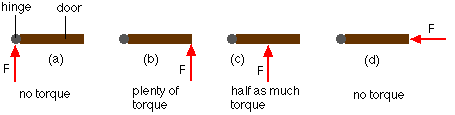
In its simplest, we can look at torque through an open door. By this, I mean, where and in what direction should we push or pull on a door to give the most angular acceleration around its hinges? What does experience tell you? Have a think?
Torque is simply force at a distance. That is, the force multiplied by its distance from the axis of rotation. The angle between the force vector and the radial vector, from the axis to the point of application of the force is perpendicular component of the force, Fsin(theta). This component makes the object rotate and is maximized at the perpendicular, or 90 degrees where sin(90) = 1!
Torque has direction, in terms of clockwise (CW) and counterclockwise (CCW). CCW is seen as the positive direction.
The “Line of Action” of this force is the extension of the force vector through the point where the force is exerted. The Lever Arm or Moment Arm, as we saw in the arm wrestling video, is the perpendicular distance form the rotation axis to the line of action of the force. See below.
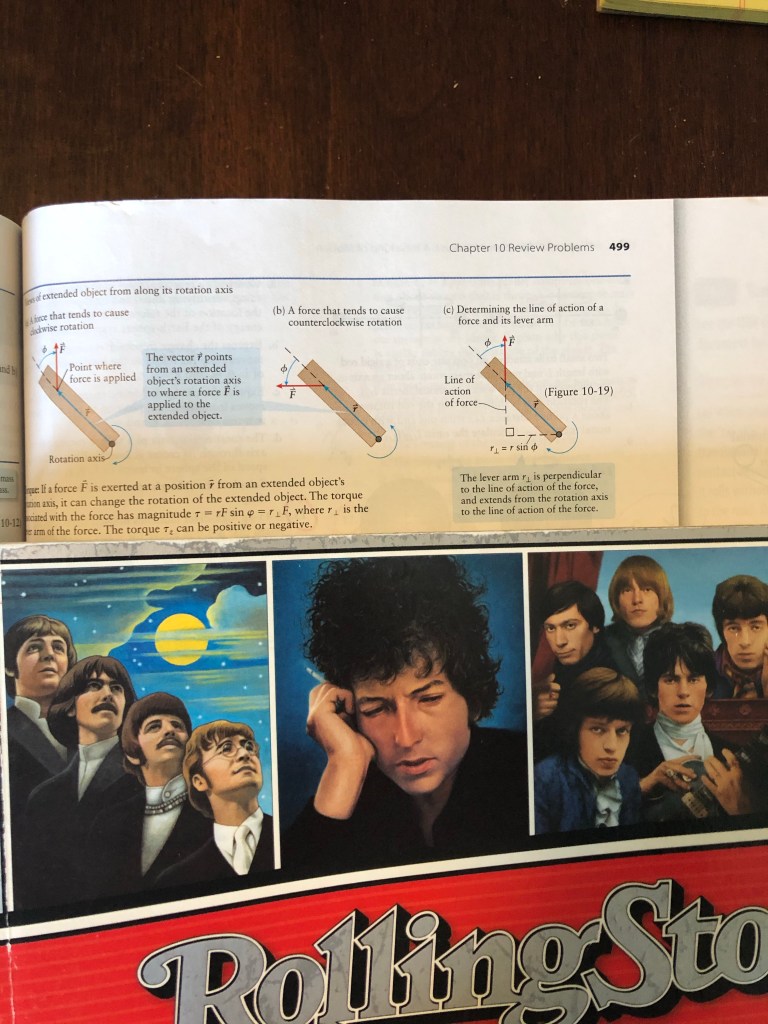
Torque (tau) = F x r (sin(theta))
…or…
Torque (tau) = F x r(perpendicular)
Torque is also the rotational equivalent of force!! So we can also express the sum of the torques relating to our favorite formula.
Sum (torques) = I (alpha)
The Rotational Equivalent to Newton’s 2nd Law!!
The ability to set these equations equal to each other allows us to analyze rotational motion problem from several aspects and we will get into this in a little bit!

Theresa holds a 10 kg kettle ball in one hand at arm,s length and at shoulder height. Assuming her hand is 75 cm from her shoulder and neglect any torque caused by the weight of your arm, what is the torque about Theresa’s shoulder axis?
Angular Momentum!!!
Just like linear momentum, angular momentum is constant when there are no external torques exerted on the system!! So just like our formula for torque, angular momentum expresses the rotational equivalents of linear momentum.
L = Iw

The interesting this bit about angular momentum is, that, if an object is traveling in linear motion, it has angular momentum with respect to the the axis of rotation it’s about to collide with!! The formula for the initial angular momentum of a point mass in linear motion is represented below.
L = mvr
Just as in linear momentum, the angular momentum before the collision can be set equal to the angular momentum after the collision if there are no external torques.
Iw(before) = Iw(after)
🍕 This wonderful relationship solves the mystery of the pizza toss!! 🍕
HERE are some fantastic wrap up questions for this unit!!

 Film Clas